The server never sees the picture
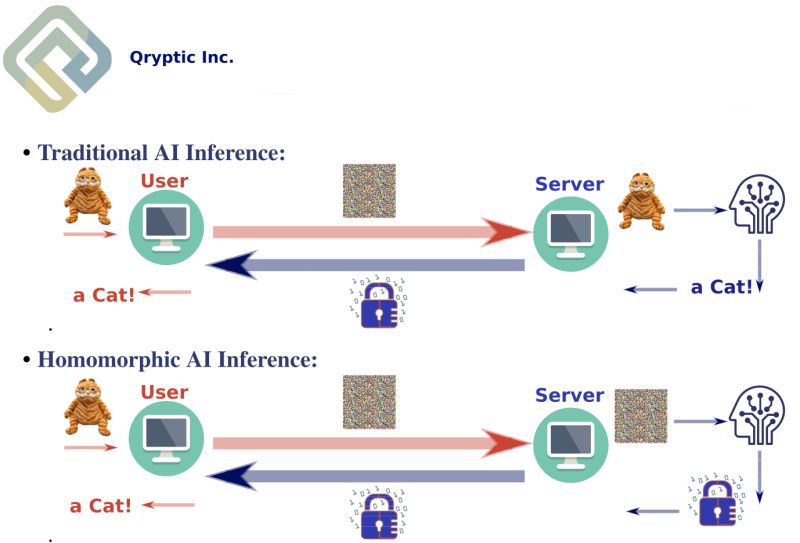
Imagine you have a picture of a cat, and you want to use AI to identify it. In the traditional AI inference method, the process involves sending the image to a server for analysis. However, before the AI engine can process the image, it first needs to be decrypted, exposing the raw image data to the server. Once decrypted, the AI engine detects the object (in this case, a cat) and returns the result in the form of text — “a cat!” — which is then encrypted and sent back to the client.
In contrast, homomorphic encryption provides a game-changing solution. With homomorphic encryption, the image is encrypted before it’s even sent to the server. The AI engine processes the encrypted data directly — without ever seeing or decrypting the raw image. The inference result is also encrypted before being sent back to the client. The client is the only one with the key to decrypt and view the result.
This means that the server never has access to the image or the result, ensuring complete privacy throughout the entire inference process. Homomorphic encryption acts as an additional layer of security on top of existing protocols, safeguarding sensitive data without interfering with existing workflows or protocols already in place.
This innovative approach offers a level of privacy and security that traditional methods can’t match, making it the ideal solution for industries that require strict data confidentiality and integrity.